General Terms
Last updated: 14.08.2026
On this page, you can find the General Terms of JUNE GmbH. They set out the general framework for the provision and use of JUNE’s cloud-based services, including provisions on access, support, data security, usage rights, and other contractual matters.
Internationale Anwaltskanzleien und Unternehmen vertrauen auf JUNE


















1. Definitions
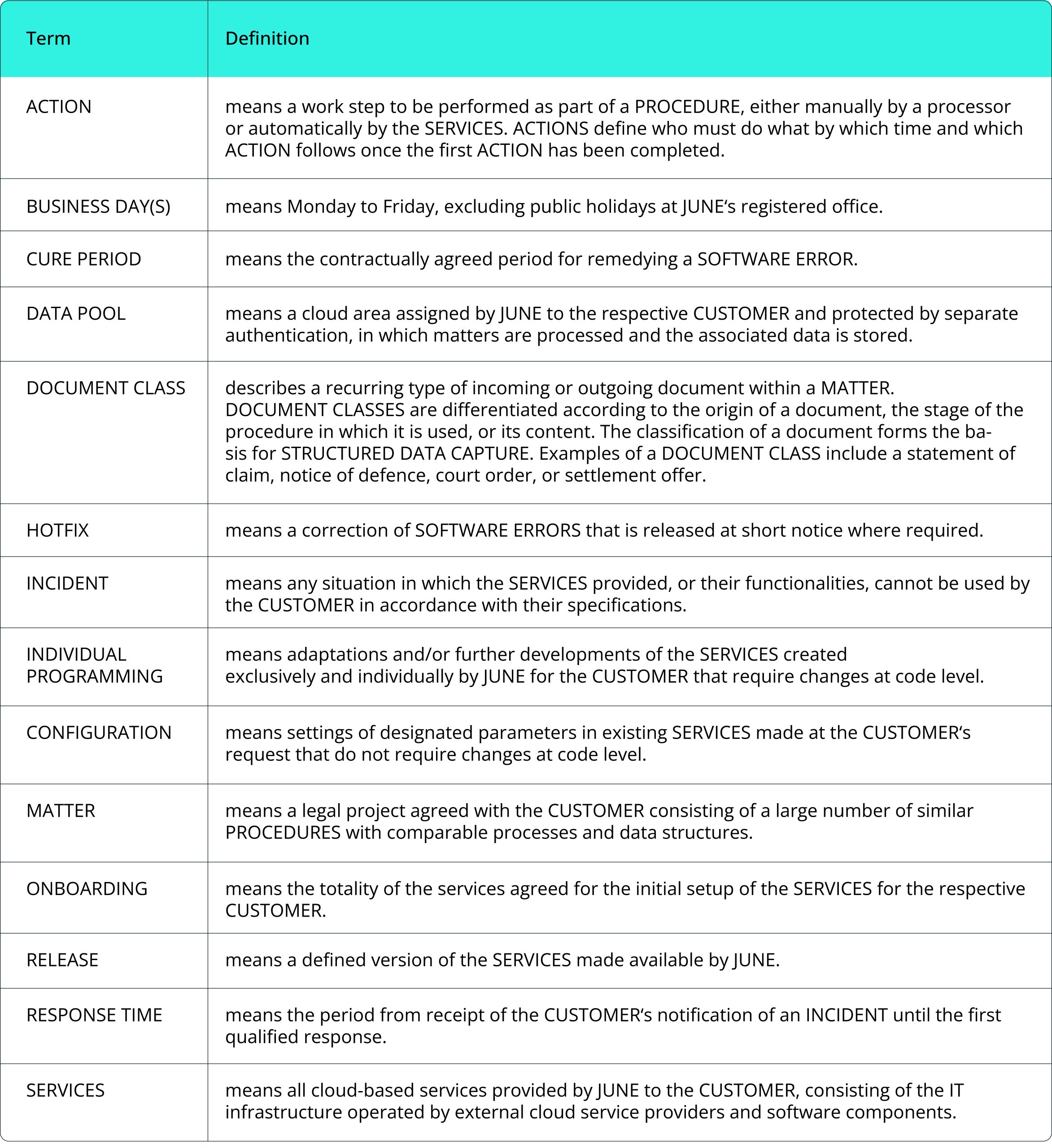
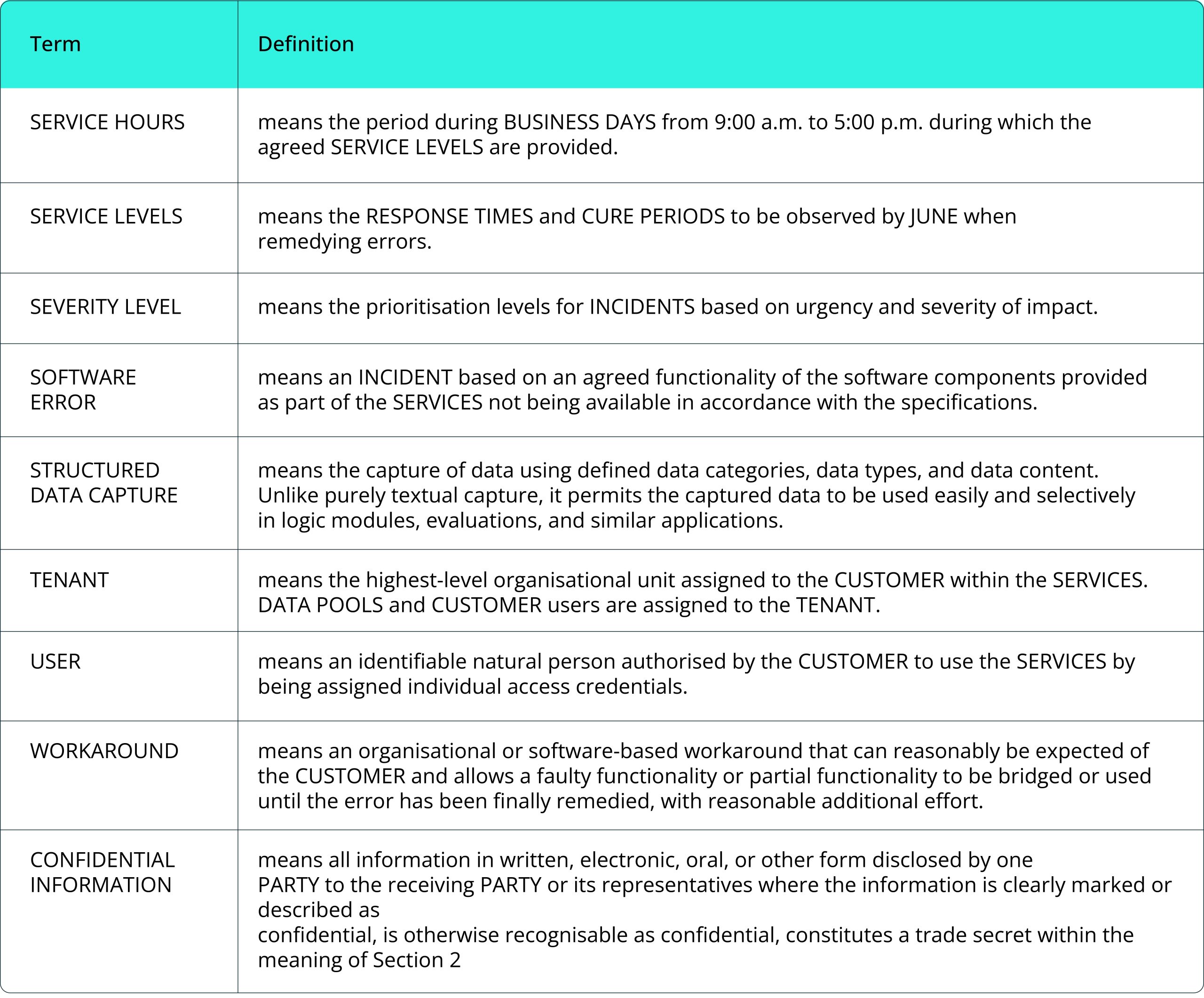
Terms written in capital letters have the following meaning:
2. Subject matter of the contract; description of services
The SERVICES to be provided by JUNE are conclusively defined in the Master Agreement and the annexes referred to therein.
This agreement replaces all previous oral, written, or other agreements between the PARTIES.
2.1 Provision of the SERVICES
During the term of the SaaS Agreement, JUNE provides the CUSTOMER with SERVICES for the administration, processing, and handling of legal proceedings in high-volume business. The SERVICES provided are designed for the processes, workflows, and incidents typically involved in high-volume proceedings and are developed dynamically and iteratively.
A general description of the scope of functions of the SERVICES is set out in the Performance Description annex, which may be updated as required or continued through release notes. The SERVICES ordered by the CUSTOMER are set out in the Offer annex.
The provision of the SERVICES also includes all new RELEASES of the SERVICES that JUNE makes available to the CUSTOMER during the term within the booked scope of services.
For the SERVICES provided, the CUSTOMER receives online help (FAQs), documentation of the system requirements to be created by the CUSTOMER, and, in the case of new RELEASES, corresponding release notes.
2.2 Access to the SERVICES
Each USER accesses the SERVICES by login and password together with an additional authentication factor. All logins are individual and may only be used by the respective authorised USERS. Within the agreed scope, the CUSTOMER may create logins for its own employees or clients.
The CUSTOMER may also create logins for third parties who are neither its employees nor its clients, within its own usage rights. The creation of logins for third parties must be recorded in the user administration. The CUSTOMER shall ensure through suitable contractual agreements with the relevant third parties that the logins are used only by USERS authorised by the CUSTOMER.
The CUSTOMER shall ensure that the logins and passwords created are kept confidential by the authorised
USERS and protected against unauthorised access. JUNE reserves the right to reject or subsequently block logins created or used by the CUSTOMER contrary to these requirements.
The CUSTOMER must keep the access credentials confidential and protect them against unauthorised access. The CUSTOMER shall impose corresponding confidentiality obligations on its employees and authorised third parties. If misuse is suspected, the CUSTOMER shall inform JUNE without undue delay. JUNE reserves the right to change access credentials for security reasons and shall inform the CUSTOMER without undue delay in such a case.
2.3. Onboarding
The SERVICES are designed so that the CUSTOMER can make the adjustments and configurations required during ongoing operation to meet its individual needs by setting designated parameters itself.
For the initial setup of the SERVICES and their adaptation to the CUSTOMER’s individual workflows, JUNE provides the following ONBOARDING services to the extent specified in the Offer annex.
2.3.1 Basic setup of the SERVICES
JUNE initially sets up the SERVICES for the CUSTOMER, creates a TENANT in the CUSTOMER’s name, and creates the agreed number of DATA POOLS. JUNE initially creates user accounts for the CUSTOMER’s employees. The CUSTOMER provides JUNE with a list of employees and email addresses for this purpose. JUNE assigns the CUSTOMER’s users to a DATA POOL. After the initial setup, the CUSTOMER manages the user accounts itself.
2.3.2 Initial setup of document classes and workflows
JUNE conducts workshops with the CUSTOMER to define the ACTIONS and follow-up ACTIONS, DOCUMENT CLASSES, and data fields required for the project launch. The CUSTOMER provides JUNE in advance with information about the planned processes, relationships, and incoming and outgoing document types. JUNE then sets up the DOCUMENT CLASSES and workflows for the CUSTOMER.
As agreed, JUNE generally provides advice and workshops for setting up MATTERS, sets up a defined number of ACTIONS and follow-up ACTIONS, sets up incoming DOCUMENT CLASSES with a defined number of data fields, and sets up a defined number of outgoing DOCUMENT CLASSES. This includes administrator training for user administration and rights management, workflow administrator training for workflow and data configuration, document administrator training for rights management and template creation and maintenance, training for the person responsible for first-level support, and end-user training covering the dashboard, ACTION processing, document creation, and file processing.
2.3.3 Training on the platform
To the agreed extent, JUNE trains the CUSTOMER’s USERS in the use of the SERVICES. The services are provided online or at the CUSTOMER’s premises as agreed by the PARTIES. JUNE offers additional training and support services on request, subject to availability and for a separate fee.
2.3.4 Transfer of legacy data
For the transfer of legacy data from other systems, JUNE provides an import format. The transfer of legacy data that cannot be imported using this format is not part of ONBOARDING and is subject to a separate fee. The transfer of legacy data generally requires manual post-processing. The details shall be agreed by the PARTIES on a case-by-case basis.
2.4 Ordering of additional services (PROFESSIONAL SERVICES)
At the CUSTOMER’s request, JUNE shall, subject to availability and against separate remuneration based on time and effort, provide services beyond Section 2.3 during ONBOARDING, in particular for adapting the SERVICES, INDIVIDUAL PROGRAMMING and CONFIGURATION services, specific interface connections, or additional support and consulting services (together, “PROFESSIONAL SERVICES”). The remuneration for PROFESSIONAL SERVICES is set out in the Offer annex.
2.5 Scope of services
The following services are not included in the SaaS Agreement in particular: provision, operation, maintenance, and upkeep of the technical infrastructure required on the CUSTOMER’s side, including browsers, firewalls, data connections, and all other system requirements for using the SERVICES; monitoring, checks, and actions required as part of the CUSTOMER’s professional obligations; establishing interoperability with systems of the CUSTOMER or third-party systems not listed in the Performance Description annex; and maintaining the CUSTOMER’s document templates, text modules, dashboard configurations, user administration, and ACTION workflows.
3. Availability
JUNE shall make economically reasonable efforts to keep the SERVICES available and operational for access and use by the CUSTOMER. During the term of this agreement, JUNE shall ensure the availability specified in the Master Agreement, measured over a calendar year.
Availability excludes predefined maintenance windows, emergency downtime required to install security updates at short notice and without prior notice, and special times agreed between the PARTIES for urgent non-recurring work on the SERVICES (DOWNTIMES). The agreed maintenance windows are Wednesday from 8:00 p.m. to 6:00 a.m. the following day and Sunday from 12:00 noon to midnight.
Availability is calculated without taking into account defined maintenance windows, DOWNTIMES, impairments, and causes for which JUNE is not responsible, including use of the SERVICES contrary to the agreement, loss of the internet connection, failure to meet the minimum system requirements set out in the Performance Description annex, force majeure, data corruption caused by the CUSTOMER, acts or omissions of third parties outside JUNE’s control, and unauthorised changes to the configuration of the SERVICES by the CUSTOMER.
4. Data security and backups
JUNE uses exclusively services provided by the agreed subcontractors, such as cloud services and database management systems, to process and store the CUSTOMER’s data. The CUSTOMER may access the data stored by subcontractors for it in connection with using the SERVICES. The CUSTOMER remains the sole authorised party with respect to its matter-related data and may request the return or deletion of some or all data with reasonable advance notice, taking into account JUNE’s and the subcontractor’s business hours and access rules. Technical configuration data is excluded.
JUNE does not locally store or process the CUSTOMER’s data in analogue form. The cloud service providers used by JUNE store the CUSTOMER’s data redundantly and in geographically distributed locations in certified data centres in Germany in accordance with comprehensive compliance certifications, including ISO 27001, ISO 27017, ISO 27701, ISO 27018, SOC 1, SOC 2, SOC 3, C5, or the BSI IT-Grundschutz standard.
The CUSTOMER’s data is protected against external attacks such as DDoS attacks. Security criteria are continuously monitored in the Azure Security Center using Azure Defender. Data transfers (TLS/SSL) and storage of the CUSTOMER’s data are encrypted, currently using AES-256. All JUNE SERVICES and virtual machines are shielded from the outside world by virtual networks (VNETs) and are available only through a secure VPN connection with certificate verification. Matter-related case data is generally stored separately for each CUSTOMER. Project-separated storage may be agreed separately at the CUSTOMER’s request.
The CUSTOMER’s data is backed up at least as follows: backup every six hours, retained for seven days; daily backup, retained for seven days; weekly backup, retained for four weeks; monthly backup, retained for twelve months; and annual backup, retained for five years. Further backup services and restoration measures must be agreed and remunerated separately. If the CUSTOMER requires additional backups to fulfil professional, tax, or other statutory obligations, it shall create them on its own responsibility.
5. Support und Maintenance
5.1 Hotline and support
During SERVICE HOURS, Monday to Friday from 9:00 a.m. to 5:00 p.m., excluding public holidays in Bavaria, JUNE provides a support organisation for reporting INCIDENTS. Support requests may be submitted by the CUSTOMER’s first-level support directly through the support function in JUNE or, where necessary, by email to support@june.de.
5.2. First-level support
The CUSTOMER shall ensure first-level support during the term of the agreement. The CUSTOMER’s first-level support is the first point of contact for all INCIDENTS. If an INCIDENT cannot be resolved, first-level support shall forward it to JUNE’s second-level support.
When reporting an INCIDENT to JUNE’s second-level support, the CUSTOMER shall ensure that the INCIDENT is described comprehensively and completely, an assumed SOFTWARE ERROR is initially classified under the agreed SEVERITY LEVELS, all information, data, and documents required to describe the INCIDENT are provided, and JUNE is granted any system access required to analyse the INCIDENT.
5.3 Second- and third-level support
Second-level support is provided by JUNE application specialists. Immediately after receiving a report from the CUSTOMER’s first-level support, second-level support creates a ticket documenting the further processing status and analysis of the problem. If the INCIDENT cannot be resolved by second-level support, it is forwarded to JUNE’s third-level support, which is staffed by programmers.
5.4 Reporting INCIDENTS
INCIDENT reports are recorded by JUNE as tickets. They must contain at least a meaningful title describing the essential facts, a comprehensible description of the actual situation, the conditions required for the INCIDENT to occur, a reproducible description of the situation where possible, a comprehensible description of the expected correct functionality from the CUSTOMER’s perspective, a justified priority based on the SEVERITY LEVELS, the reason for the importance of the issue, the number of affected USERS and the consequences, any dependencies, and references to other related tickets.
5.5. Severity levels
JUNE remedies SOFTWARE ERRORS according to the following SEVERITY LEVELS. The CUSTOMER initially classifies a SOFTWARE ERROR; JUNE reviews the classification and may raise or lower it.
Severity Level 3 (High): A material and relevant part of the SERVICES is unavailable or inaccessible, making it impossible to work with the SERVICES and/or causing critical business impact. This includes, in particular, a
SOFTWARE ERROR that causes the loss of an essential function and cannot be remedied by a WORKAROUND, or that damages or causes the loss of data.
Severity Level 2 (Medium): The SERVICES are generally available but so severely impaired that use is more than insignificantly affected, for example because individual important functions are unavailable. The CUSTOMER can continue working with restrictions.
Severity Level 1 (Low): The SERVICES are available but their use is partially impaired for some or all USERS, for example because individual functions of minor importance are unavailable. The CUSTOMER’s work is affected only insignificantly.
5.6 Response and cure periods
JUNE handles SOFTWARE ERRORS classified under Section 5.5 during SERVICE HOURS according to the following periods:
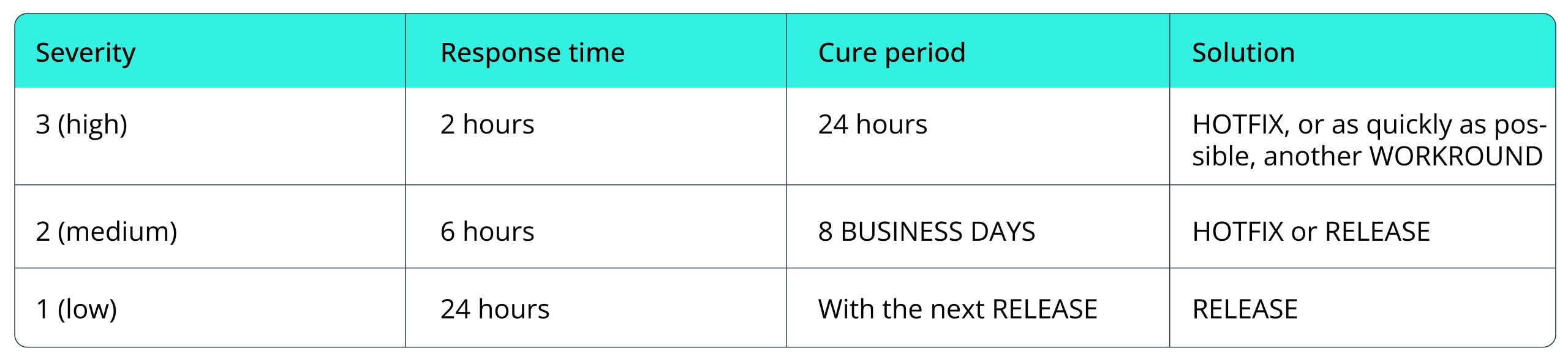
If the CUSTOMER is in default with the cooperation required to remedy the SOFTWARE ERROR and JUNE is consequently unable to work on the remedy, the CURE PERIOD is extended by the duration of the delay.
INCIDENTS that are not SOFTWARE ERRORS are forwarded by JUNE to the relevant subcontractors for further processing.
5.7 Consequences of failing to meet response and cure periods
The stated RESPONSE TIMES and CURE PERIODS apply only if the CUSTOMER has provided JUNE with the information, documents, and any prerequisites required to remedy the SOFTWARE ERROR, such as remote access to demonstrate the INCIDENT. If these prerequisites are not met, JUNE shall inform the CUSTOMER of the missing information, documents, or prerequisites and their impact on the SERVICE LEVELS and grant a reasonable further period for provision. If the further period expires unsuccessfully, JUNE shall grant a second reasonable further period. If this also expires unsuccessfully, the SERVICE LEVELS shall no longer apply. If the CUSTOMER subsequently provides the information and documents or creates the prerequisites, JUNE shall process the SOFTWARE ERROR within a reasonable period.
If the RESPONSE TIME or CURE PERIOD is not met, the CUSTOMER may claim a standard reduction based on the monthly remuneration last determined under the Offer annex as follows:
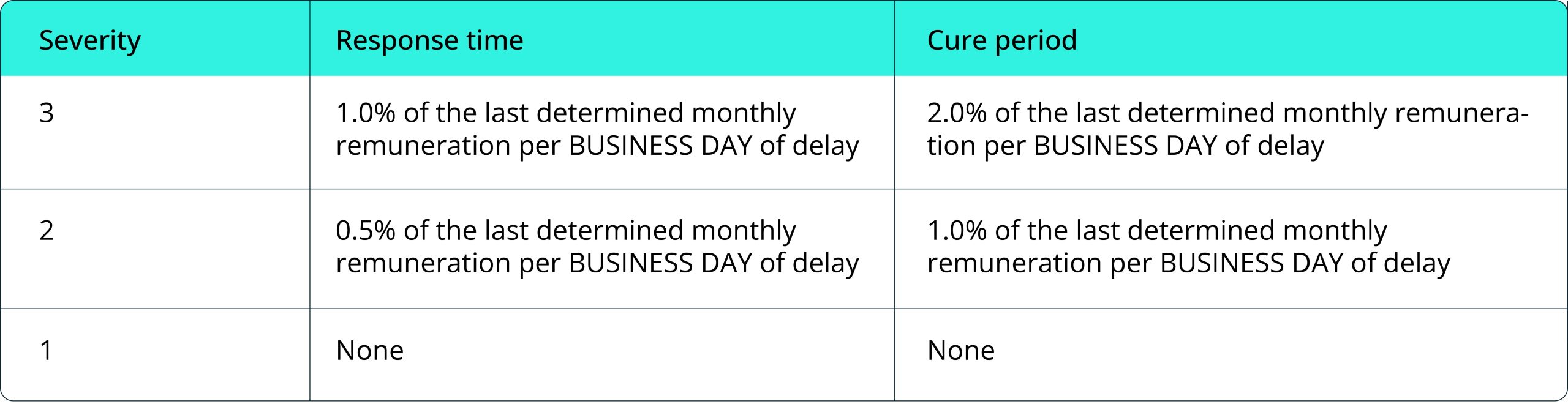
The maximum standard reduction for failure to meet the RESPONSE TIME and/or CURE PERIOD in any quarter is 10% of the remuneration for that quarter determined on the basis of the Offer annex. If no further failure to meet the RESPONSE TIME or CURE PERIOD for Severity Level 3 or 2 occurs in the same quarter, the reduction calculated under the table is not due for the relevant event with the identical SEVERITY LEVEL. The standard reduction compensates all damage arising in connection with the failure to meet the RESPONSE TIME and/or CURE PERIOD. If the RESPONSE TIME and/or CURE PERIOD is not met for a Severity Level 1 SOFTWARE ERROR, the CUSTOMER has no claim for damages in cases of negligence. In cases of intent, the statutory provisions apply.
6. CUSTOMER cooperation
6.1 Cooperation duties
For the contractual use of the SERVICES, the CUSTOMER shall ensure that it maintains suitable internet access; its hardware and software, including workstations, routers, data communication equipment, and similar equipment, meet the minimum technical requirements; its software components used to create the system requirements include all current security updates; the software components, templates, graphic elements, fonts, and similar elements used by it permit use in a cloud application; and the required data backup measures are established and maintained throughout the term, in particular careful and diligent handling of logins and passwords.
The CUSTOMER is also responsible for configuring its IT system unless it has commissioned JUNE to do so under a separate agreement. Depending on the purpose and criticality of the SERVICES, the CUSTOMER shall, where necessary, prepare an emergency plan for a complete or partial failure of the SERVICES.
6.2 Failure to cooperate
If the CUSTOMER fails to provide its cooperation duties, provides them late, or provides them improperly, JUNE may invoice any additional effort incurred as a result. If cooperation is essential to or substantially facilitates
JUNE’s provision of the SERVICES, JUNE may grant the CUSTOMER a reasonable further period. If that period expires without success, JUNE may terminate the relevant agreement for good cause.
7. Grant of rights
7.1 Rights to use the SERVICES
Against payment of the remuneration agreed in the Offer annex, JUNE grants the CUSTOMER the non-exclusive and non-transferable right to use the SERVICES during the term of the agreement as a SaaS service for their intended purpose. The rights and restrictions in this Section also apply to all new RELEASES of the SERVICES.
7.2 Rights to further developments
The PARTIES agree that all intellectual property rights, in particular copyrights, in further developments of the SERVICES, including additional programming, interface connections, and special requests, as well as the commercial property rights arising from trademark and competition law, shall remain unrestricted with JUNE. If the CUSTOMER contributes protectable components, such as technical concepts and specifications, in the conception or development of further developments, the CUSTOMER grants JUNE, upon creation, exclusive, perpetual, transferable, and unrestricted rights to use and exploit those components in terms of time, territory, and subject matter. JUNE may edit, modify, adapt, and further develop them and may distribute them to third parties as part of the SERVICES without the CUSTOMER’s consent and without separate remuneration. The CUSTOMER is not entitled to separate remuneration for this grant of rights.
7.3 Rights to INDIVIDUAL PROGRAMMING
The content and scope of the rights granted in relation to INDIVIDUAL PROGRAMMING agreed between JUNE and the CUSTOMER in an individual case shall be subject to a separate agreement.
7.4 Rights to CONFIGURATION
The CUSTOMER may adapt the SERVICES to its individual needs by setting designated parameters. JUNE maps the CUSTOMER’s standard workflows in cooperation with the CUSTOMER during ONBOARDING. JUNE grants the CUSTOMER unrestricted rights, in terms of time, territory, and subject matter, to use CONFIGURATION created by JUNE for the duration of this agreement. The CUSTOMER grants JUNE rights to CONFIGURATION created by the CUSTOMER, its employees, or third parties to the extent required to fulfil JUNE’s contractual obligations. Otherwise, JUNE may use the CONFIGURATION without the CUSTOMER’s consent for internal development and testing purposes and, in anonymised form and while protecting the CUSTOMER’s business and trade secrets, for presentation and demonstration purposes, and incorporate it into the standard SERVICES.
7.5 Reproduction
The CUSTOMER may reproduce the software components provided as a SERVICE only to the extent required for intended use. This includes storing UI components in the browser cache and loading software components into working memory.
7.6 Transfer to third parties
The CUSTOMER acknowledges that it is not entitled to pledge, assign, rent, sublicense, publish, or otherwise communicate or transfer the SERVICES, in whole or in part, to third parties for consideration or free of charge. JUNE grants the CUSTOMER the right to allow third parties access to the SERVICES for the CUSTOMER’s own business purposes within the CUSTOMER’s agreed usage rights. The CUSTOMER shall ensure through suitable contractual agreements that access is granted only for the duration and purposes of the contractual agreements between the CUSTOMER and the third party. The CUSTOMER shall ensure that third parties comply with the SaaS Agreement and other applicable legal requirements. The CUSTOMER is responsible for breaches by those third parties as for its own acts and shall indemnify JUNE comprehensively.
7.7 Other restrictions on use
In addition to the restrictions in Sections 7.5 and 7.6, the CUSTOMER shall refrain, itself or through third parties, from performing any copyright-relevant act not expressly permitted by the rights granted; decoding, reverse engineering, disassembling, decompiling, deriving source code from object code, or otherwise deriving or attempting to derive the internal structure, functionality, or other internal processes of the licensed SERVICES or software components, subject to mandatory statutory provisions; translating or converting the licensed SERVICES, software components, or documentation; removing or obscuring copyright or trademark notices; impairing the functionality of the SERVICES through SQL injection, DDoS attacks, or similar harmful acts; attempting to circumvent protective measures; or using or permitting the SERVICES or documentation to be used with content containing offensive or adult material and/or depictions of violence in a manner that may be considered immoral or illegal or that discredits JUNE’s reputation or goodwill.
7.8 Rights to data
The CUSTOMER remains the sole authorised party with respect to the matter-related data processed by it through the SERVICES, including correspondence, master data, and case data, and may request the return of some or all of its data at any time. The CUSTOMER grants JUNE the right to use the data in anonymised form for statistical purposes and to further develop the SERVICES. Upon termination of the contractual relationship, JUNE shall promptly make all the CUSTOMER’s matter-related data stored in the storage space assigned to it available to the CUSTOMER. To provide the data, JUNE shall enable the CUSTOMER to transfer data backups to an account designated by the CUSTOMER with a cloud service provider. The CUSTOMER is not entitled to receive the software suitable for using the data or the technical configuration and technical process data. JUNE has neither a right of retention nor a statutory landlord’s lien under Section 562 of the German Civil Code with respect to the CUSTOMER’s data.
7.9 Data use for AI applications
JUNE ensures that the CUSTOMER’s matter-related data is not used or incorporated by JUNE for training or as input content in components of the SERVICES based on artificial intelligence, unless the PARTIES expressly agree otherwise or the use occurs exclusively in the CUSTOMER’s interest and not in the interest of JUNE or a third party.
7.10 Open-source components
The use of open-source software code in the SERVICES shall always be documented in a form comprehensible to third parties. JUNE shall provide this documentation to the CUSTOMER free of charge and keep it up to date. JUNE ensures that applicable open-source licence provisions do not result in a copyleft effect for the CUSTOMER.
8. Remuneration
The remuneration for the SERVICES provided by JUNE and any additional services is set out in the Offer annex. If the assumptions underlying the Offer annex change materially after conclusion of the agreement, JUNE may request an adjustment of the agreed remuneration. Unless expressly agreed otherwise, the prices applicable at the time of commissioning apply to all services ordered subsequently.
9. Term
9.1 Commencement, duration, and ordinary termination
The commencement of the agreement, ordinary termination periods, and any minimum terms are set out in the Master Agreement.
9.2 Extraordinary termination
Either PARTY’s right to extraordinary termination of the SaaS Agreement or individual SERVICES for good cause under Section 314 of the German Civil Code remains unaffected. Where objectively justified, the terminating PARTY may specify a reasonable wind-down period.
Good cause exists where, taking into account all circumstances of the individual case and weighing the mutual interests, continuation of the contractual relationship can no longer reasonably be expected of the terminating PARTY. If the good cause consists of a breach of a contractual duty, termination is permissible only after a reasonable period to remedy the breach has expired unsuccessfully or after an unsuccessful warning, unless the basis of trust for continuing the relationship has already been so seriously undermined by the first breach that it cannot be restored by granting a remedy period or issuing a warning.
Good cause exists in particular if a PARTY breaches a material provision of this agreement and fails to remedy the breach within a reasonable period, but at least forty-five calendar days after receiving a corresponding request from the other PARTY; insolvency or comparable proceedings are applied for or threatened against a PARTY; the CUSTOMER is in arrears with payment of JUNE’s invoices for three consecutive months or in an amount corresponding to the average invoices for three months, provided JUNE has previously requested payment in writing; or there is sufficient suspicion that the CUSTOMER has breached the restrictions on use under Sections 7.5 to 7.7. The CUSTOMER may avert the relevant measure by clearing the suspicion at its own expense through suitable evidence.
Termination for good cause may only be declared within three months after the PARTY entitled to terminate becomes aware of the grounds for termination. If the overall assessment of a series of events entitles a PARTY to terminate, the period begins with the last event.
9.3 Effects of termination or other end of the agreement
In all cases of termination, JUNE shall, at the CUSTOMER’s request, continue to provide the SERVICES for a transitional period after termination as part of exit management, subject to payment. The details are set out in Section 10. Section 16 continues to apply after termination. If the CUSTOMER exercises the extension option as part of exit management, Sections 16, 18, and 19 also continue to apply for the extension period.
9.4. Form
All notices of termination must be in writing.
10. Exit Transition
10.1 Extension option
If this agreement ends for any reason, JUNE shall, following the CUSTOMER’s written declaration of extension, postpone the termination date for all or part of the services by up to six months to ensure an orderly transition to a successor provider. The CUSTOMER must exercise the extension option no later than thirty days after receiving the notice of termination and must state the scope of the extension. Until then, JUNE shall continue providing the agreed services under the SaaS Agreement on the previously agreed terms.
10.2 Winding-down services
Upon termination, the PARTIES shall jointly ensure the orderly winding down of the services under the SaaS Agreement. In particular, the PARTIES shall return or, following agreement, securely delete documents, data, and other items exchanged under the SaaS Agreement within a reasonable period, unless statutory retention periods apply or the items are required for evidence.
10.3 Support for transition to a successor system
At the CUSTOMER’s request, JUNE shall, subject to availability and against separate remuneration based on time and effort, provide support for transitioning the services under the SaaS Agreement to a successor system. The PARTIES shall agree the specific scope of support.
11. Warranty and liability for defects
JUNE warrants the functionality and operational readiness of the SERVICES provided in accordance with the agreed availability. If the contractually agreed availability or SERVICE LEVELS for remedying defects are not met, the CUSTOMER’s rights resulting from reduced usability of the SERVICES are governed exclusively by Section 5.7. The right to terminate or claim damages in lieu of performance exists only in the event of material defects in the contractually agreed service.
12. Third-party rights
12.1 Principle
JUNE warrants that the contractual use of the SERVICES does not infringe third-party rights. If claims are asserted due to actual or alleged infringement of third-party rights through the CUSTOMER’s use of the SERVICES, the PARTIES shall inform each other in writing without undue delay. The PARTIES shall coordinate the defence of such claims closely, with JUNE taking conduct of the proceedings to the extent permitted by applicable procedural law. JUNE shall bear the reasonable costs of the CUSTOMER’s legal defence.
If the contractual use of the SERVICES is impaired due to an assertion of third-party rights, JUNE may, at its own cost and option, modify the SERVICES so that the rights are no longer infringed, obtain the right for unrestricted contractual use, or provide a comparable replacement.
12.2 Indemnification
If the CUSTOMER incurs costs, damage, or obligations in connection with defending, handling, or resolving third-party rights claims relating to the SERVICES, JUNE shall indemnify and hold the CUSTOMER harmless from costs or obligations imposed by a final court judgment or arbitral award, costs or obligations recognised in a settlement, and the costs of reasonable legal defence. If the CUSTOMER incurs costs, damage, or obligations, including reasonable legal defence costs, as a result of a settlement, indemnification requires that JUNE has either consented to the settlement or, after being requested and given a deadline, failed to take over conduct of the dispute with the third party.
12.3 Further rights
If a court prohibits use of the SERVICES or parts of them due to an alleged infringement of a third party’s rights, JUNE may, at its own option and cost, obtain the right for the CUSTOMER to continue using the SERVICES, replace the SERVICES or affected parts with functionally equivalent elements, or modify them so that they no longer give rise to an infringement. If none of these measures is possible, JUNE shall refund the remuneration paid for the affected parts for the duration of the impairment on a pro rata basis. This Section 12 conclusively governs liability for third-party rights. The indemnity applies only to third-party claims arising from use of the SERVICES in the EU, EEA, and Switzerland.
12.4 Limitation period
Claims under this Section 12 become time-barred two years after the CUSTOMER becomes aware of the facts giving rise to the claim.
13. Liability
13.1 Principle
JUNE has unlimited liability in cases of intent or gross negligence, for injury to life, body, or health, under the German Product Liability Act, and to the extent of a guarantee assumed by JUNE.
13.2 Limitation of liability
In the event of a slightly negligent breach of a duty that is essential to achieving the purpose of the agreement (cardinal duty), JUNE’s liability is limited in amount to the damage foreseeable and typical for the type of business in question. There is no further liability on the part of JUNE. In particular, JUNE is not liable for initial defects unless the requirements for unlimited liability under Section 13.1 are met. This limitation also applies to the personal liability of JUNE’s employees, representatives, and corporate bodies.
13.3 Scope of liability
In the event of liability under Section 13.2, the following are not recoverable: lost profit, loss of revenue, loss of goodwill or damage to reputation, and unrealised savings such as staff reductions, restructuring, or efficiency gains.
13.4 Use of AI-based results
The CUSTOMER is aware that the SERVICES generate automation results based on data extraction and artificial intelligence. AI is based on training data and algorithms reflecting a particular state of knowledge. That state of knowledge may become outdated and fail to reflect new developments or current information. AI may also contain errors, inaccuracies, or omissions, making professional and substantive review by the CUSTOMER indispensable. The use of automation results is not a substitute for expert and professional, in particular legal, review. The automation results provided by JUNE are merely work aids when using the SERVICES and do not replace substantive review by the CUSTOMER.
The CUSTOMER is therefore aware that responsibility for applying the automation results lies exclusively with the CUSTOMER. JUNE accepts no liability for the accuracy, completeness, or currency of the automation results or for direct or indirect damage resulting from applying them.
13.5 Breach of professional obligations
JUNE is not liable for damage arising from a breach of professional rules that the CUSTOMER must observe due to its membership of a particular profession, such as the BRAO, BORA, FAO, RVG, rules on cross-border activities, or professional additions to general statutory provisions such as the GwG. Responsibility for compliance with these provisions and general laws lies exclusively with the CUSTOMER.
13.6 Contributory negligence
If damage is attributable both to JUNE’s fault and to the CUSTOMER’s fault, the CUSTOMER’s contributory negligence shall be taken into account. In particular, if unauthorised third parties use the CUSTOMER’s access credentials to obtain SERVICES, the CUSTOMER is liable for the resulting remuneration if the CUSTOMER is at fault for the unauthorised access.
14. Insurance
JUNE confirms that it maintains insurance for financial losses and property and personal injury losses during the term of the agreement in the amount of EUR 5 million per individual event and a maximum of EUR 15 million per calendar year. JUNE also confirms cyber insurance in the amount of EUR 250,000 per individual event, including EUR 50,000 for restoration of IT hardware.
15. Force majeure
Force majeure means any unforeseeable, serious event outside a PARTY’s sphere of influence that prevents a PARTY wholly or partly from performing its obligations, including war, terrorist conflict, epidemics, industrial action, fire, flooding, strikes, operational disruptions not caused by the PARTY, official orders, and lawful lockouts.
The affected PARTY shall inform the other PARTY without undue delay of the occurrence and end of the force majeure event. It shall use its best efforts to remedy the force majeure event and limit its effects as far as possible. The PARTIES shall adapt this agreement to the changed circumstances in good faith. For the duration and extent of the direct and indirect effects, the PARTIES are released from their obligations and owe no damages in this respect. If an adjustment in good faith is not equitable, either PARTY may terminate this agreement for cause if it is foreseeable that the obligations will be prevented for more than three months.
16. Confidentiality
16.1 General
CONFIDENTIAL INFORMATION may be used only to perform the SaaS Agreement. The PARTIES shall treat CONFIDENTIAL INFORMATION as strictly confidential and take all necessary measures to prevent unauthorised third parties from accessing it. The PARTIES may disclose CONFIDENTIAL INFORMATION only to third parties who need to know it, including employees and subcontractors involved in the performance.
The PARTIES shall also maintain confidentiality regarding the content of the SaaS Agreement and information obtained during its performance. The confidentiality obligation continues after the contractual relationship ends.
The PARTIES shall impose corresponding confidentiality obligations on persons assisting them.
16.2 References and press releases
CUSTOMER’s logo. JUNE may also publicly reproduce or refer to the services provided and generally offered by the CUSTOMER in its business for demonstration purposes, including in a case study, unless the CUSTOMER can assert a legitimate conflicting interest. Press releases, information, and similar communications in which one PARTY refers to the other require prior written coordination.
17. Professional obligations
17.1 CUSTOMER obligations
The CUSTOMER is solely responsible to its clients for complying with all professional obligations and all general laws applicable to processing matters. This includes compliance with and monitoring of deadlines and appointments, assertion of claims, objections, and defences, and proper invoicing of remuneration owed to the
CUSTOMER.
The CUSTOMER shall ensure that any declarations, approvals, or consents required from its clients for processing matters through the SERVICES are available and remain in place for the duration of use. This applies in particular to all data protection consents where JUNE processes personal data of the CUSTOMER’s clients on behalf of the CUSTOMER or has it processed by JUNE’s subcontractors.
17.2 JUNE obligations
Data that may be subject to professional secrecy within the meaning of Section 203 of the German Criminal Code is processed under this agreement. JUNE undertakes to maintain secrecy regarding professional secrets and to obtain knowledge of such data only to the extent required to perform the agreed processing. The details are set out in the Annex to Section 203 of the German Criminal Code.
18. Data security
Each PARTY shall ensure appropriate data security during transmission over public telecommunications facilities or through the SERVICES. The PARTIES shall ensure that access to the computer systems used complies with all statutory or regulatory requirements and that access to data is protected against unauthorised handling by appropriate technical and organisational measures.
The PARTIES shall use all reasonable efforts to achieve the best possible protection against viruses, worms, Trojans, and other malware in accordance with the state of the art. The PARTIES shall inform each other without undue delay in text form of suspected breaches of agreed security measures or other security incidents relevant to the security of the agreed services and cooperation duties and shall support each other to a reasonable extent in limiting or remedying damage. Security incidents include all events that breach the protection objectives of availability, confidentiality, or integrity with respect to the CUSTOMER’s data processed by JUNE or its subcontractors.
The PARTIES shall monitor the data-processing systems within their respective areas of responsibility, including applications, networks, and data centres, for breaches of these protection objectives. Physical breaches, such as breaches relating to access control, must also be monitored. A PARTY shall notify the other PARTY without undue delay in the event of a breach of a protection objective.
19. Data protection and subcontractors
The PARTIES undertake to comply with applicable data protection requirements, in particular the GDPR and the German Federal Data Protection Act. For processing personal data on behalf of the CUSTOMER, the PARTIES shall conclude a data processing agreement. If subcontractors, such as cloud service providers, are engaged to process personal data on behalf of the CUSTOMER, JUNE shall, where required, conclude corresponding data processing agreements with them to ensure compliance with the requirements of the data processing agreement with the CUSTOMER. JUNE has provided the CUSTOMER with a list of the subcontractors used in advance of entering into the agreement and shall notify the CUSTOMER of changes.
20. Disagreements
If disputes or disagreements arise out of or in connection with the SaaS Agreement, the PARTIES shall endeavour to resolve them amicably. Each PARTY must first notify the other PARTY in reasonable detail of any disagreement, problem, or conflict of which it becomes aware.
For disagreements arising out of or in connection with the SaaS Agreement that the PARTIES cannot resolve between themselves, the PARTIES shall promptly initiate mediation by an independent mediator. If the PARTIES cannot agree on a mediator within 14 days after receipt of a PARTY’s written request to initiate mediation, the board of the Gesellschaft für Wirtschaftsmediation und Konfliktmanagement e. V., based in Munich, shall appoint a mediator.
Each PARTY shall bear its own costs, including any advisers or representatives it engages. All other costs of mediation, such as the mediator’s fees, shall be borne equally by the PARTIES. If the PARTIES do not reach agreement through mediation within 30 days after receipt of the above written request, either because an initial meeting with the mediator was unsuccessful or has not taken place, they may pursue legal proceedings. The failure of mediation shall be declared to the other PARTY in writing without undue delay after expiry of that period.
The admissibility of urgent court proceedings remains unaffected.
During amicable resolution, mediation, or court proceedings, the PARTIES shall continue to perform their obligations under this agreement notwithstanding the dispute or disagreement.
21. Final provisions
21.1 Place of performance
The place of performance is JUNE’s registered office.
21.2 Governing law
The SaaS Agreement is governed by German law, excluding the United Nations Convention on Contracts for the International Sale of Goods (CISG).
21.3 Place of jurisdiction
The place of jurisdiction is Munich.
21.4 Written form
Amendments and supplements to the SaaS Agreement must be made in writing to be effective; email satisfies the written-form requirement. This also applies to an amendment of this provision. Amendments and supplements must also expressly refer to the agreement being amended or supplemented.
There are no oral side agreements to the SaaS Agreement. Declarations must be made in writing to be effective; email also satisfies the written-form requirement, except in the case of termination or rescission.
21.5 Severability
If a provision of the SaaS Agreement is invalid, this shall not affect the validity of the remaining provisions. The invalid provision shall be replaced by a valid provision that comes as close as possible to the economic purpose pursued by the contracting parties. The same applies if the agreement contains a regulatory gap.