EU261 · Passenger rights
EU261 claims management and automation
Manage high volumes of EU261 passenger claims arising from flight delays, cancellations and denied boarding with structured workflows built for scalable case handling.
Used by teams handling thousands of passenger claims per month

EU261 · Claim timeline
- End of journey after a disruption
- 3 h €250–600 Arrival delay that triggers compensation – unchanged by the reform Compensation, depending on flight distance
- 96 h To inform passengers about their right to compensation after the end of the journey (reform)
- 30 days To pay a claim or reject it with reasons (reform)
International law firms and corporations trust JUNE

















The challenge
EU261 claims increase operational pressure on airlines
Regulation (EC) No 261/2004 created a harmonised legal framework for air passenger rights in the event of delay, cancellation and denied boarding. As a result, airlines face a steady stream of passenger claims – compensation demands as well as claims for reimbursement, re-routing and care.
Handling large volumes of claims under Regulation (EC) No 261/2004 places a significant operational burden on airlines. High case volumes, recurring review steps and strict deadlines make efficient, consistent processing difficult. The EU261 reform – Regulation (EU) 2026/2202, applicable from 23 October 2027 – increases this pressure further: the 3-hour threshold and the compensation amounts of €250 to €600 remain, while airlines will have to inform passengers about their right to compensation within 96 hours after the end of the journey – which is expected to push case volumes up further.
Explained
What is EU261?
EU261 is a European regulation governing passenger rights in the event of flight delays, cancellations and denied boarding. Depending on the situation, passengers may be entitled to compensation (€250–600 depending on flight distance), reimbursement, care or alternative transport. The duty of care applies regardless of fault, and the airline bears the burden of proof for extraordinary circumstances.
For airlines, EU261 means recurring operational work. High volumes of passenger claims require consistent processes for intake, review, communication and handling – often across several teams or external partners.
The regulation applies in particular to:
- Flights within the EU
- Flights departing from the EU
- Flights into the EU, if operated by an EU carrier
- Passenger claims relating to delays, cancellations and denied boarding under EU261
Claim types
Types of EU261 compensation claims
Under EU261, airlines can face different types of compensation claims, depending on the disruption and the circumstances of the individual case. Although the legal basis is standardised, these passenger claims still require consistent review, documentation and handling across teams. The most common claim types include:
EU261 · Claim timeline
- End of journey after a disruption Claim types Arrival delays of 3 hours or more at the final destination Cancellations of the booked flight Denied boarding in particular due to overbooking Missed connections under certain conditions
- 3 h €250–600 Arrival delay that triggers compensation – unchanged by the reform Compensation, depending on flight distance
- 96 h To inform passengers about their right to compensation after the end of the journey (reform)
- 30 days To pay a claim or reject it with reasons (reform)
JUNE for Airlines
Automated passenger claims management with JUNE
Classification and extraction
Let JUNE digitize and extract relevant information from all incoming documents. JUNE understands and classifies documents from different sources based on context to assign them to the corresponding case.
Smart automation
From batch deadline checks to mass correspondence, all at the push of a button. Smart, modular workflows allow your team to swiftly process even the largest mass cases.
Seamless collaboration
Create dedicated workspaces to collaborate in real time with external counsel and internal stakeholders – with individual triggers, deadlines and workflows.
Built for EU261
Built for EU261 claim workflows
EU261 claims follow recurring patterns, but still require structured handling of deadlines, documentation and legal assessments. For airlines handling a high volume of passenger claims, this means continuous operational effort.
JUNE lets teams steer the EU261 process in a structured way. Claims are processed on the basis of predefined logic, deadlines are monitored automatically, and similar cases can be handled consistently and at scale. Justified claims are settled quickly, while cases involving extraordinary circumstances are contested on time and with evidence.
With JUNE for Airlines, the flight becomes the unit of work: every claim is linked to its flight by flight number, date and departure airport, the legal team decides once per flight, and JUNE applies that decision to every linked claim – including claims filed weeks later.
- of incoming documents handled automatically
- up to 75 %
- less processing time per claim
- up to 60 %
- reduction in legal workload
- up to 80 %
Up-to values. Actual results depend on process type, volume and integration depth.
Turn EU261 caseloads into structured workflows
When large volumes of EU261 claims arrive via email, portals or third-party platforms, teams have to capture, structure and assess each case quickly. Unstructured claim intake leads to delays, manual effort and inconsistent case handling.
JUNE automatically captures and organises incoming EU261 claims, turning unstructured data into structured case files – the basis for a consistent claims handling process.
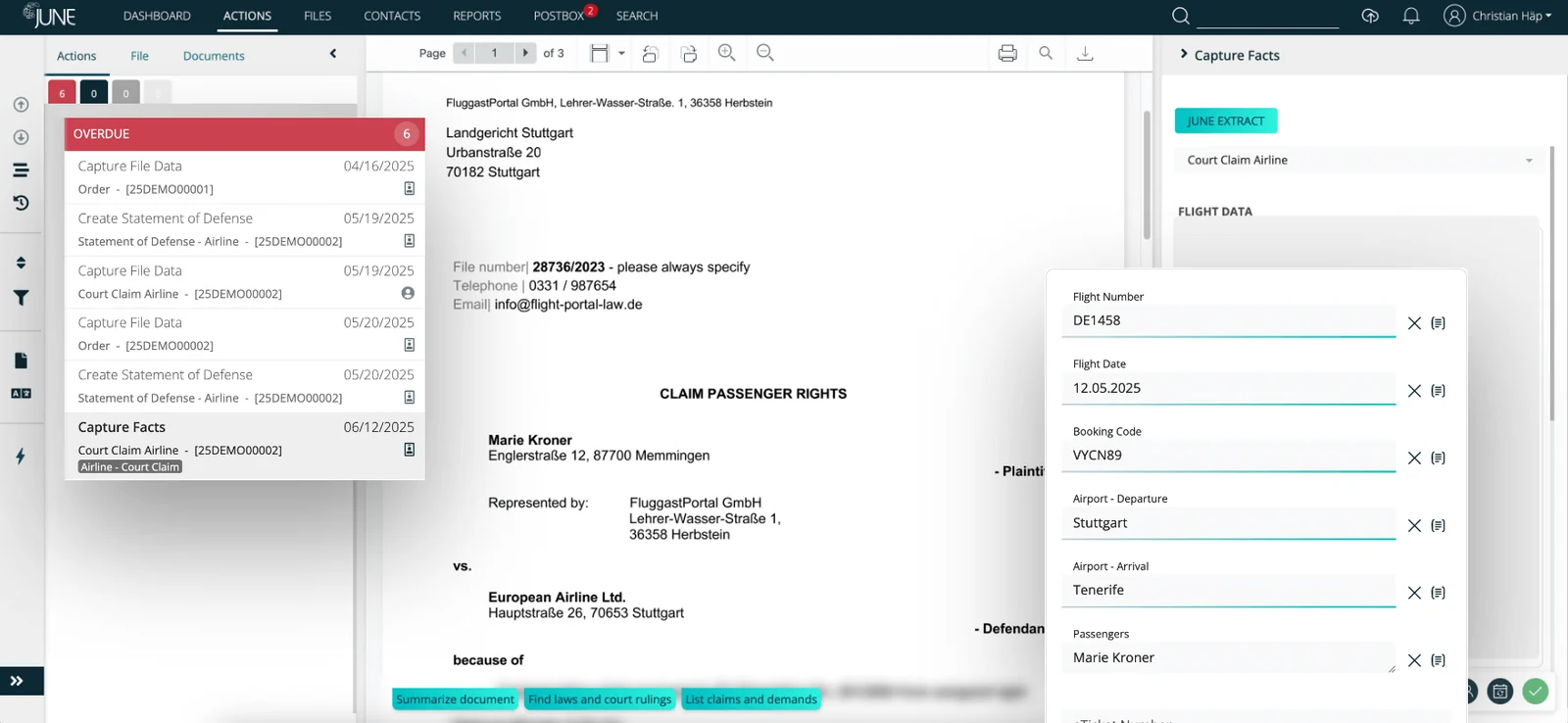
Consistent handling with rule-based workflows
Rule-based workflows apply your own EU261 criteria at every step: deadlines are set, tasks assigned and documents prepared the same way for similar cases. This reduces manual effort and keeps high volumes of passenger claims moving.
The legal decision stays with your team – including whether extraordinary circumstances rule out compensation. JUNE then applies it consistently across the entire EU261 process.
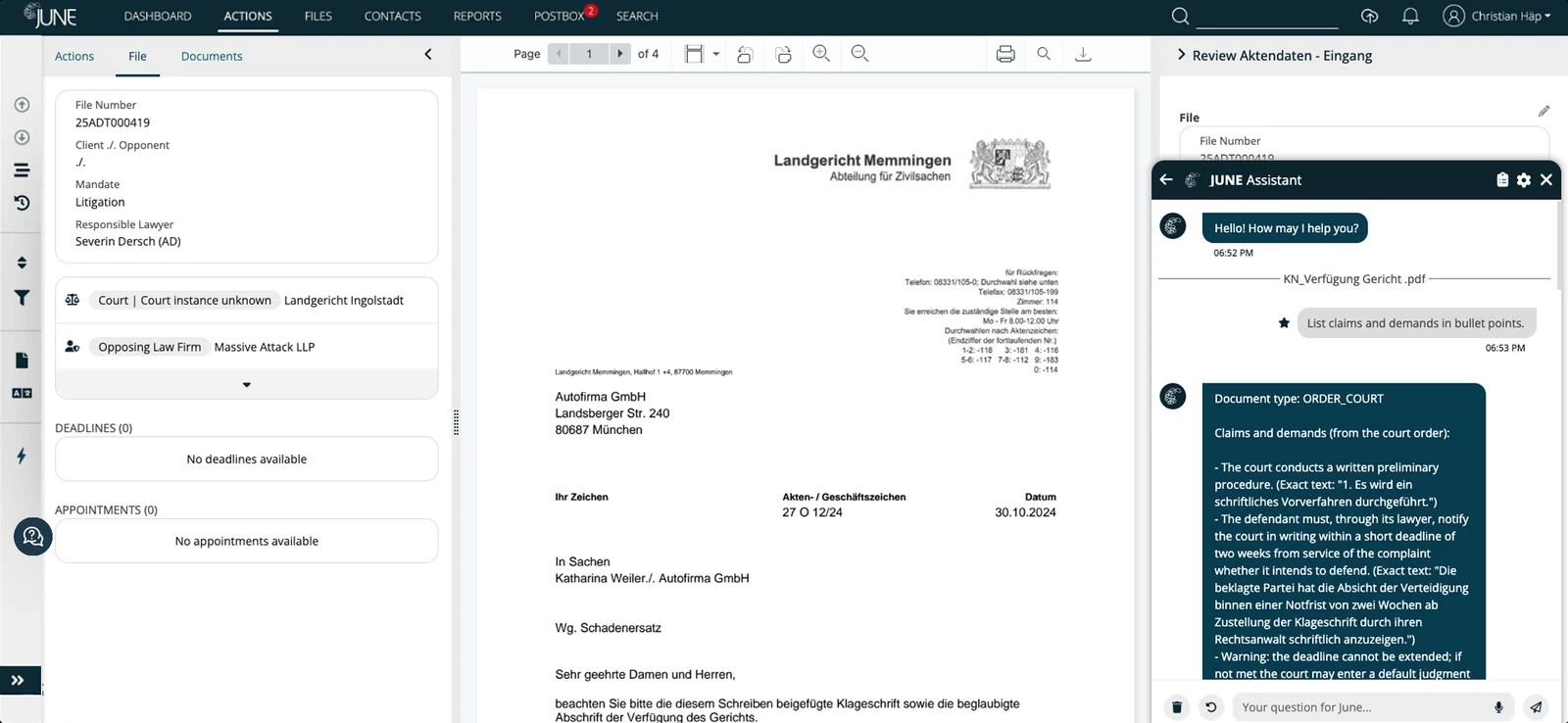
Standardised handling and communication for EU261 claims
Standardised workflows ensure that responses, follow-ups and escalations are handled consistently across all EU261 claims. This reduces manual coordination and keeps communication between internal stakeholders and external partners uniform.
For airlines facing recurring compensation claims, structured handling improves consistency, transparency and operational control.
Request a free demo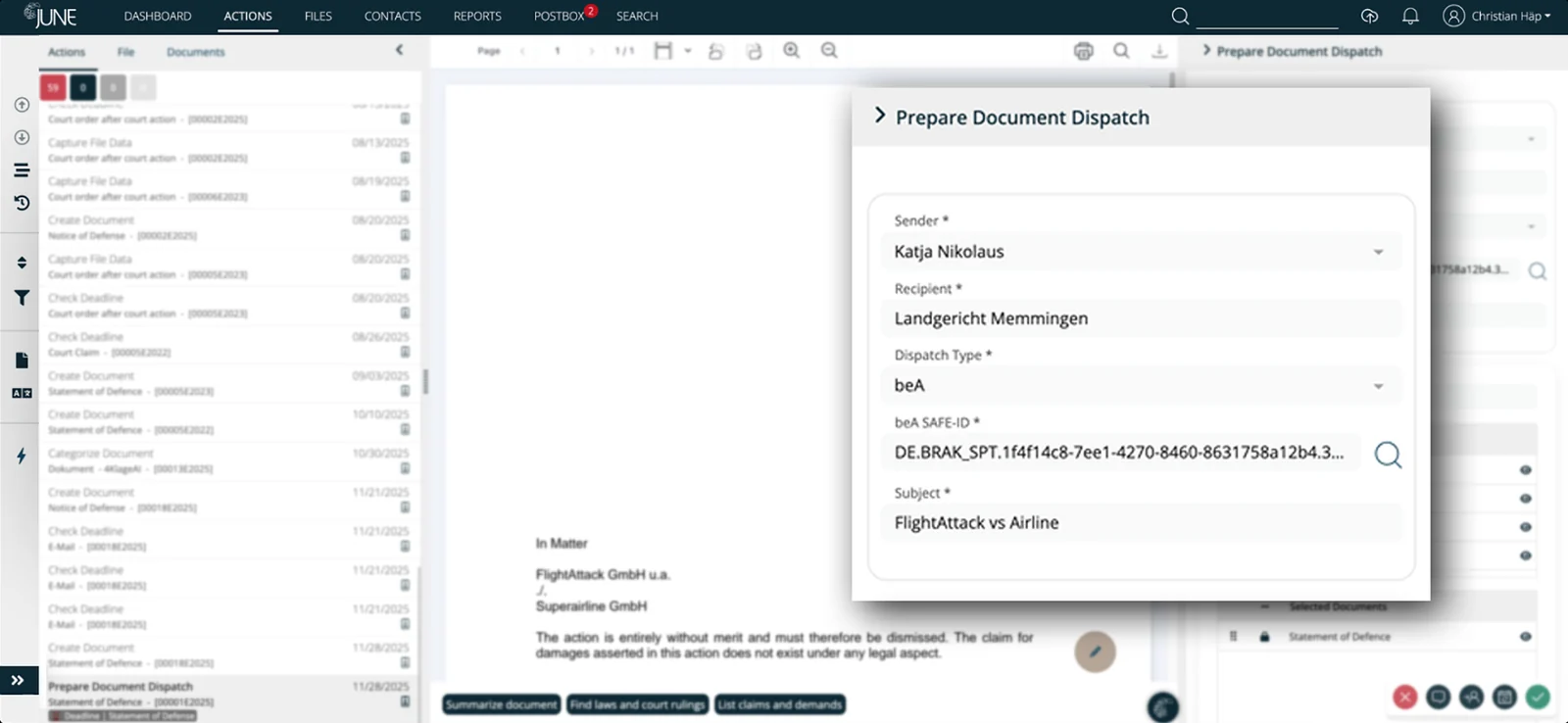
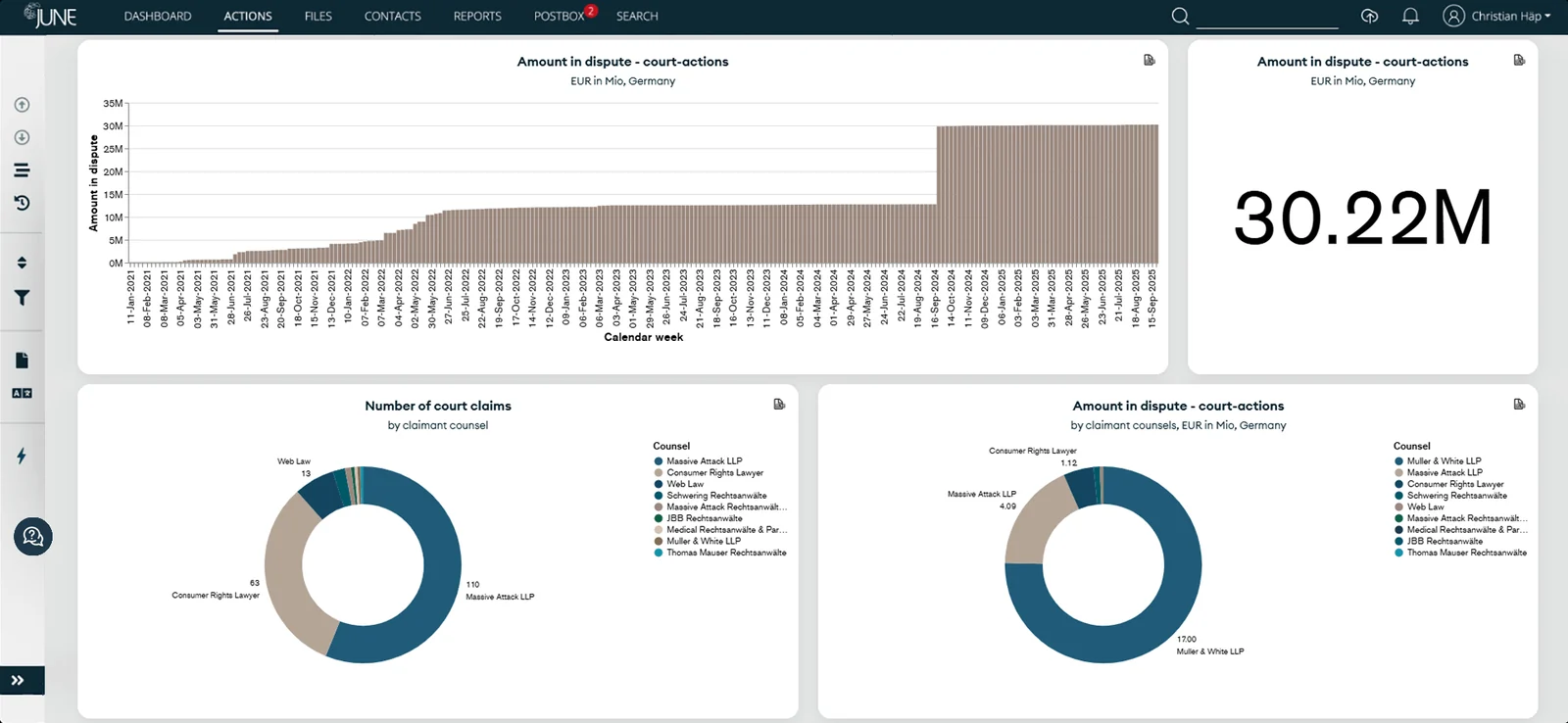
Full visibility across all EU261 claims
All cases, deadlines and outcomes are captured in a single system, giving teams full control over high case volumes.
This creates transparency and improves operational performance management.

Customer story
How Lufthansa transformed passenger litigation management
Facing a steady rise in passenger claims under the EU air passenger rights regulation, Lufthansa replaced fragmented, manual processes with a central data hub and JUNE’s AI-powered case management platform. The result: response times cut from days to around 20 minutes per case, higher accuracy and secure collaboration with external law firms – giving legal teams room for strategic work.
~20 min
response time per case – previously days or weeks
“With JUNE, we’ve transformed our previously analog and largely paper-based handling of passenger claims into a digital, data-driven process. The platform provides us with the relevant information for each case in the shortest possible time and enables secure collaboration with our external law firms. What previously required time-consuming manual coordination, we now complete in just a few minutes with greater accuracy and full transparency across all teams.”

Free demo
Together towards more structure and control in your legal operations
JUNE helps legal teams manage cases, automate workflows and handle complex legal processes efficiently from intake to resolution.
What to expect:
- A free consultation and tailored demo
- Expert feedback on your current setup
- An honest assessment of whether JUNE is right for you
- Clear next steps